Corpus Christi properties face severe red imported fire ant pressures due to sandy loam soils and frequent seasonal rain bursts that drive colonies out of saturation zones. In coastal developments such as Flour Bluff…
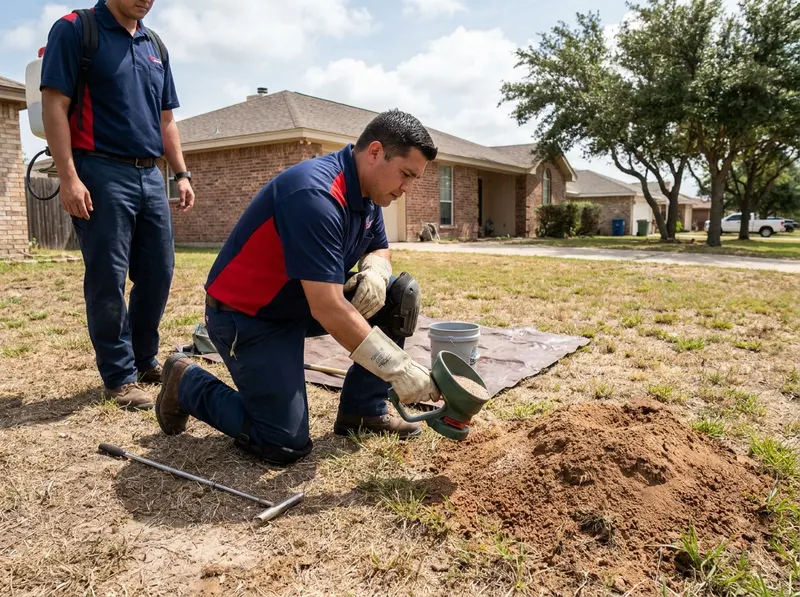
Corpus Christi properties face severe red imported fire ant pressures due to sandy loam soils and frequent seasonal rain bursts that drive colonies out of saturation zones. In coastal developments such as Flour Bluff and Cayo del Oso, high water tables force worker ants to build raised, visible mounds against concrete slab footings, irrigation boxes, and air conditioning pads. In western clay areas like Calallen and Annaville, colonies establish extensive subterranean foraging tunnels that go unnoticed until heavy rain triggers an immediate surface eruption. Surface sprays from retail stores fail because contact pyrethroids merely fragment the colony, causing the queen to relocate and multiply mounds across the lawn. Effective field management relies on low-toxicity, broadcast granular baits containing hydramethylnon or methoprene that foraging worker ants transport underground to sterilize or kill the reproducing queens.
Decision-fit protocol balances single-acre turf yards against expansive residential parcels. For standard suburban lots in Lamar Park or South Shores, a localized barrier treatment combined with broadcast baiting neutralizes active foraging zones without saturating the soil with unnecessary liquid chemicals. For larger half-acre to multi-acre properties near Kings Crossing or Bay Area parks, tractor- or spreader-applied broadcast baiting provides residual colony suppression across open turf. Mound drenches remain reserved exclusively for immediate, high-hazard mounds near patios, children's play equipment, or pet enclosures where immediate physical stings present an active hazard. Broadcast bait treatments require dry turf for a minimum of 24 to 48 hours to allow worker ants to forage the soybean-oil matrix before afternoon showers dissolve the active ingredients.
Treating coastal properties in Nueces County requires accounting for extreme salt air and high relative humidity, both of which degrade standard agricultural granular carriers rapidly. Formulations applied along coastal corridors like North Beach must utilize hydrophobic corn-grit or micro-encapsulated carriers to prevent premature bait spoilage before underground intake. The trade-off between instant contact drenching and broadcast baiting centers on speed versus total colony elimination: a liquid drench kills thousands of surface workers within 60 minutes but often misses deeper satellite chambers, whereas broadcast baiting takes up to 14 days to circulate through the colony hierarchy but systematically kills the reproductive queens to prevent satellite mound formation.
Every job gets a firm, written price after a free on-site visit.
Tell us about your fire ant management job in Corpus Christ and we'll send a clear, written quote, usually the same day.
 Brenvexa Pest Solutions